Setting the Standard for Marine Battery Design
When selecting a marine battery system, it is easy to focus on specifications and individual features. In reality, long-term performance on the water is defined by how the system is designed, engineered, and validated as a complete solution.
A true marine-grade lithium battery system must operate reliably under a complex combination of environmental, mechanical, and electrical stresses. That requires more than protection alone. It demands a deep understanding of how batteries behave in real marine conditions, supported by the engineering capability to design for these conditions from the outset.
At ePropulsion, we develop battery systems specifically for marine applications. This means investing in research, engineering, and system integration to deliver consistent performance in real-world conditions, not just in controlled environments.
The Marine Environment Is a Multi-Stress System
A useful way to understand marine battery design is to think in terms of simultaneous stress factors rather than isolated conditions.
A battery installed on a vessel is exposed to:
- Salt-laden air that accelerates electrochemical corrosion, even without direct seawater contact
- Persistent vibration across a wide frequency range, driven by hull movement, wave impact, and propulsion forces
- Mechanical shock loads during slamming in rough conditions
- High humidity that can infiltrate enclosures over time and affect insulation resistance
- Thermal cycling caused by ambient conditions and internal heat generation
- Irregular load profiles, with long idle periods followed by sudden high discharge demand
These factors interact and compound, accelerating degradation, reducing lifespan, and increasing the risk of failure in systems not engineered for marine use.
A battery that is simply sealed against water does not address these combined effects.
What Makes a Battery Marine-Grade?
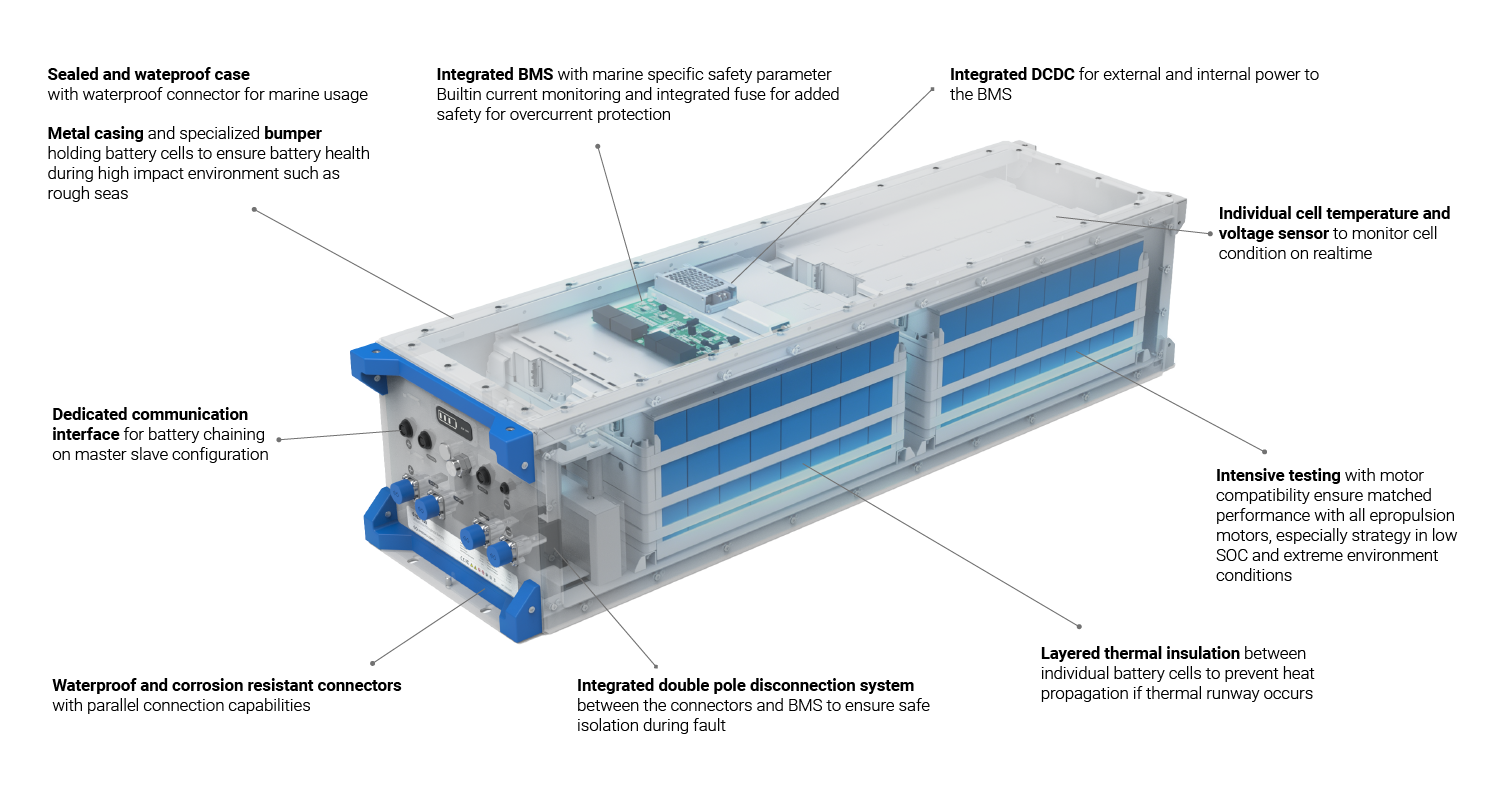
True marine-grade performance is not defined by a single feature. It is the result of coordinated engineering across multiple layers of a marine lithium battery system.
In practice, this comes down to several critical areas:
Environmental Sealing Beyond Basic Waterproofing
Ingress protection must account not only for direct water exposure but also long-term resistance to humidity and salt. This includes material selection, gasket design, pressure equalisation strategies, and connector architecture that prevents capillary ingress.
Corrosion Resistance at Every Interface
Marine degradation often begins at terminals, connectors, and fasteners. These areas require careful material pairing, protective coatings, and mechanical design that limits exposure and galvanic interaction.
Structural Integrity Under Dynamic Loads
Unlike static installations, marine batteries experience continuous motion. Internal cell fixation, busbar design, and enclosure rigidity must all be engineered to prevent micro-movements that lead to fatigue failure over time.
Thermal Stability in Constrained Spaces
Battery performance and lifespan are highly temperature dependent. Marine installations often have limited airflow, so thermal pathways must be designed to dissipate heat effectively without relying on ideal ventilation conditions.
These are system-level design decisions that determine whether a battery can operate reliably over years of marine use.
Designed for the Realities of the Marine Environment
Our battery systems are developed with the assumption that marine conditions are the baseline, not the exception.
The result is an engineering approach where mechanical, electrical, and software systems are tightly integrated rather than treated as separate layers.
Holistic System Design
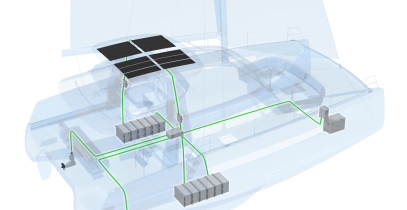
Instead of developing batteries in isolation, we design them alongside our propulsion systems. This enables direct communication between components, allowing power delivery, efficiency, and protection strategies to be optimised at a system level.
Mechanical and Environmental Engineering
The enclosure is not simply a protective shell. It is a structural component that contributes to vibration resistance, thermal management, and long-term durability. Internal layouts secure cells and electrical connections against continuous motion.
Marine-Specific Electronics Protection
Control electronics are protected not only from water ingress but also from long-term humidity exposure. This includes sealing strategies, conformal coatings, and layout decisions that reduce environmental stress.
Advanced Thermal Management
Thermal behaviour is modelled and managed to ensure cells operate within optimal temperature ranges, even in enclosed installations where heat dissipation is less predictable.
Software That Reflects Real Usage
The Battery Management System is calibrated for marine propulsion profiles, prioritising stable power delivery, accurate range estimation, and long-term battery health under irregular usage patterns.
Safety at Sea: Marine-Specific Design Matters
Safety is one of the most critical aspects of marine battery design, and it is often where the difference between purpose-built and adapted systems becomes most apparent.
Lithium batteries store a significant amount of energy in a compact space. If that energy is not properly managed, particularly in harsh environments, the consequences can be serious.
Using batteries not intended for marine conditions introduces several risks:
- Corrosion-related failure at terminals or connections
- Moisture ingress affecting internal electronics and protection systems
- Vibration-induced damage and internal wear
- Inadequate thermal management in enclosed spaces
- Unpredictable behaviour under fluctuating loads
In a marine setting, these risks are amplified by the environment and the fact that you are often operating away from immediate support.
Our systems are engineered to mitigate these risks through multiple layers of protection built directly into both the battery architecture and the wider propulsion system.
One of the most important of these is our double-pole disconnection system. If irregularities are detected in battery measurements or system operation, the battery can rapidly disconnect from the rest of the system, electrically isolating itself to help protect both the battery and connected components.
At cell level, every individual battery cell is continuously monitored through dedicated temperature and voltage sensors. This allows the system to detect abnormalities at an early stage and respond before they escalate.
In addition, layered thermal insulation is designed to help prevent localised thermal issues from propagating between cells. Rather than treating the battery as a single unit, the system continuously monitors and manages conditions throughout the entire pack.
This multi-layered approach is particularly important in marine environments, where systems are exposed to vibration, humidity, changing loads, and confined installation spaces over extended periods of operation.
Designing Battery Systems for Multiple Marine Applications
One of the most important considerations in electric marine propulsion battery systems is system voltage.
Different vessel sizes and use cases require different power architectures. That is why we have developed two dedicated battery platforms:
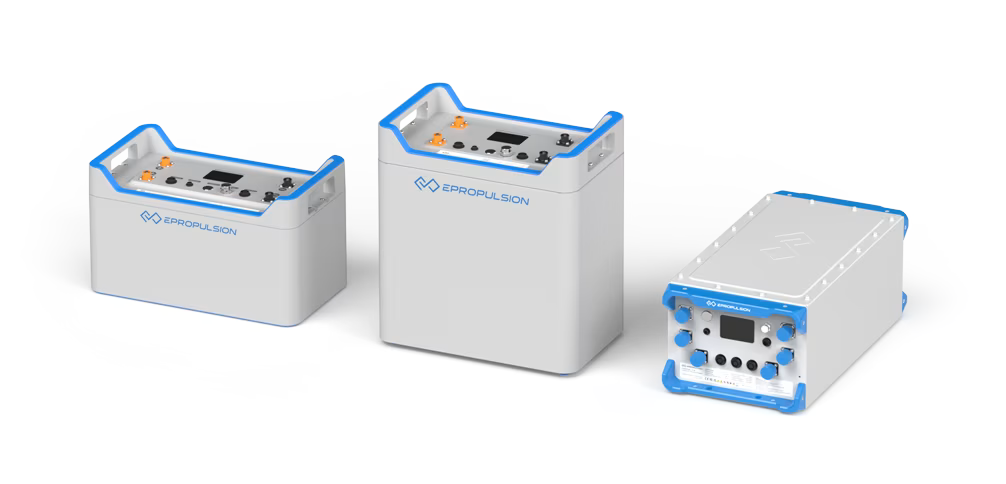
ePropulsion E-Series Battery
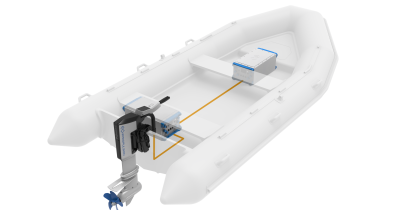
Our E-Series is designed for 48V systems, typically used in smaller vessels, tenders, and applications where simplicity, efficiency, and ease of integration are key.
These batteries deliver reliable performance in marine conditions while maintaining a compact and scalable form factor.
ePropulsion G-Series Battery
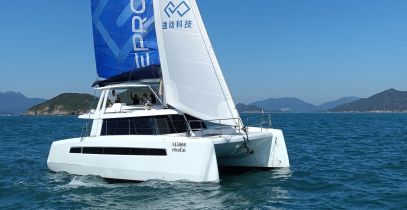
Our G-Series is built for 96V systems, supporting higher power applications and larger vessels that require greater energy capacity and output.
In these systems, structural durability, thermal management, and stable high-current delivery are even more critical.
A Flexible Approach with the ePropulsion E100 Battery
The E100 is designed to operate across both 48V and 96V architectures, providing greater flexibility for boat builders and system integrators.
This simplifies installation while maintaining the performance and reliability expected from a marine-grade system.
Marine-Grade Design at Every Scale
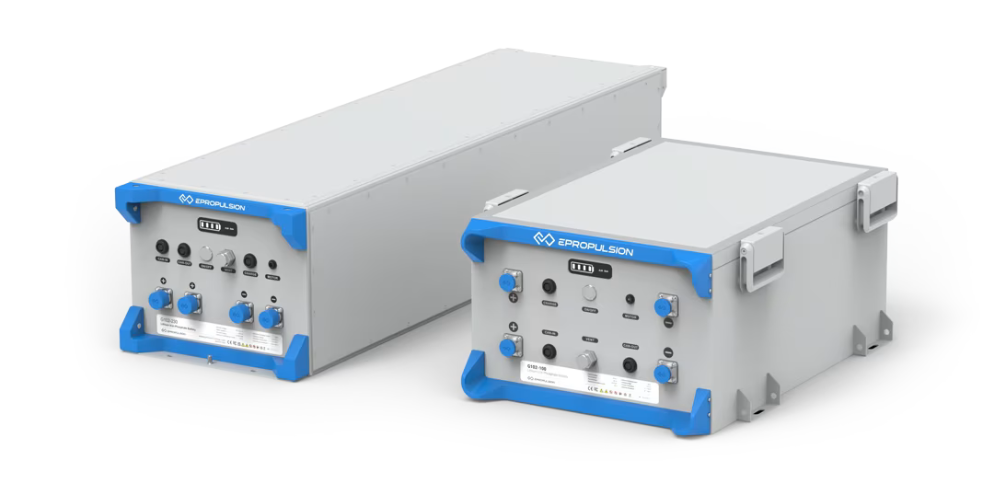
Marine-specific engineering applies across our entire battery portfolio.
Our smaller, portable batteries used with the ePropulsion Spirit range and eLite are also engineered specifically for marine use.
These systems use NMC chemistry to achieve high energy density in a compact form, while maintaining our core engineering principles:
Portable systems are often exposed to more direct handling and environmental variation, which makes robust design just as critical at this scale.
Designed as Part of a Complete System
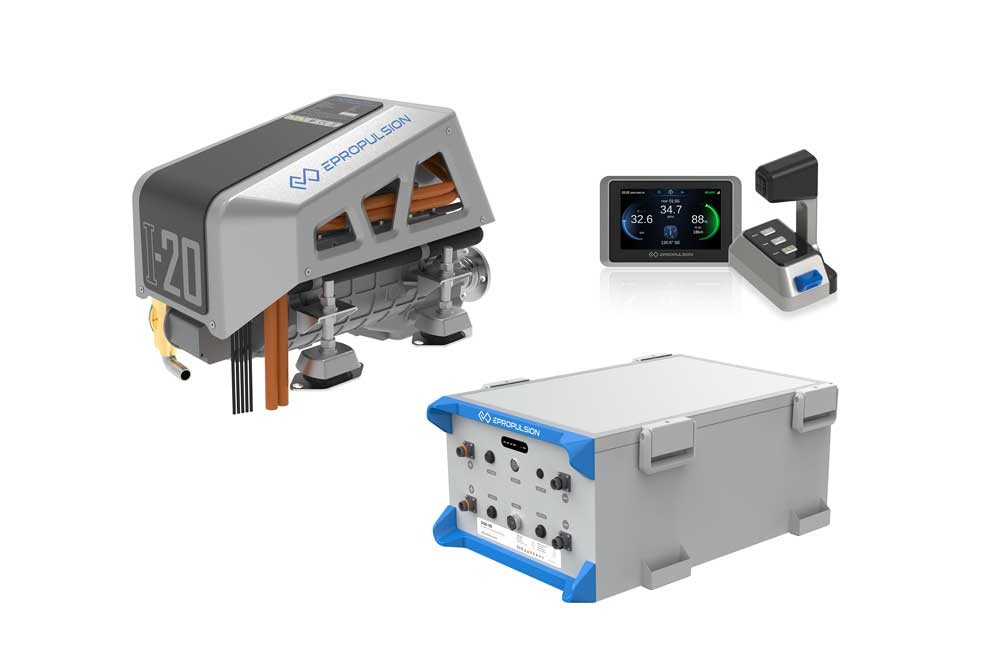
We develop our batteries as part of a fully integrated propulsion ecosystem, not as standalone components.
In many marine installations, batteries, motors, and control systems are sourced from different suppliers. While this can work, it often introduces inefficiencies, compatibility challenges, and gaps in system-level protection.
By developing our battery systems alongside our propulsion products, we engineer how each component interacts from the outset.
Direct Communication Between Components
Our batteries communicate directly with motors and control systems, enabling real-time data exchange on power demand, temperature, state of charge, and system status.
This allows the system to respond as a coordinated whole, improving efficiency while maintaining safe operating limits under changing conditions.
Because the battery and motor continuously communicate with each other, discharge behaviour and power delivery can be dynamically adjusted according to factors such as battery temperature and state of charge.
Rather than operating as isolated components, the battery and propulsion system work together to optimise performance, efficiency, and system protection in real time.
Optimised Power Delivery
Power output is precisely controlled and matched to demand, avoiding voltage drop, reducing inefficiencies, and minimising unnecessary stress on the battery.
Simplified Installation and Integration
Electrical connections, communication protocols, and safety features are designed to work together, reducing installation complexity and the risk of errors.
System-Level Safety and Protection
Protective functions operate across the entire ecosystem. If an issue is detected, the system can respond in a controlled and predictable way.
This level of integration allows the propulsion system to remain operational even if conditions move outside ideal parameters. For example, if elevated temperatures are detected within the system, the battery can continue powering the motor at reduced output, helping maintain vessel operation while keeping everything within controlled limits.
Rather than relying on abrupt shutdown behaviour, the system is designed to balance performance, protection, and operational continuity in real-world marine conditions.
Consistent Performance in Real Conditions
Integration ensures that performance on the water reflects real operating conditions, not idealised scenarios.
Smart Battery Management Is Essential
Marine propulsion places highly variable demands on a battery. A system may operate at low power for extended periods, before suddenly requiring high output for manoeuvring or changing conditions.
These rapid shifts create challenges that cannot be addressed by hardware alone.
To manage this, our Battery Management System continuously monitors cell-level performance in real time, tracking voltage, temperature, and current with high precision.
It dynamically adjusts operating limits based on conditions, maintains balance across cells during irregular usage, and provides accurate state-of-charge and range estimation.
The Battery Management System also works in continuous coordination with the propulsion system itself. Rather than operating independently, the battery and motor exchange real-time operational data, allowing power delivery to be adjusted dynamically according to temperature, operating conditions, and available battery capacity.
This coordinated approach improves efficiency, enhances system protection, and helps maintain stable operation under varying marine loads.
This level of control ensures consistent, reliable performance while protecting long-term battery health.
Rethinking What Marine-Grade Means
As electric propulsion becomes more common across the marine industry, expectations are changing.
Buyers are no longer focused solely on specifications such as capacity or voltage. Increasingly, they are considering how a marine battery system performs in real-world conditions, how long it lasts, and how well it integrates with the wider propulsion system.
A true marine-grade battery is one that is engineered for the full complexity of life on the water, combining environmental protection, structural durability, and intelligent energy management into a single, reliable system.
This is the standard we continue